

A tomato plant loaded with fruit is heavy, and without support the stems bend, snap or end up lying on wet soil where fruit rots. Staking keeps the plant upright, lets air move through the leaves, and puts the fruit where you can see and pick it.
Here’s when to stake, the four methods that work best, and how to tie stems so they stay supported without being damaged.
When to stake tomatoes
Put the stake in when you plant, not later. Driving a stake in beside an established plant can spear through the roots. Set the stake in place first, then plant the seedling 5–10cm away from it.
Do all tomatoes need staking?
-
Indeterminate (vine) tomatoes keep growing and fruiting all season and can reach 2m or more. They need a tall stake, a cage or a string trellis. Most large slicing and heirloom varieties are in this group.
-
Determinate (bush) tomatoes stop at a set height, usually under a metre, and fruit over a shorter period. A short stake or a cage is usually enough.
-
Dwarf and patio tomatoes often need little support, but a short stake still helps once they’re heavy with fruit.
Four ways to support tomatoes
1. Single stake (best for most home gardens)
Use a hardwood or bamboo stake about 1.8m long for vine tomatoes. Drive it 30cm into the ground, leaving about 1.5m above the soil. Tie the main stem to the stake as it grows. This works well with pruning, where you remove side shoots so the plant grows as one or two strong stems.
2. Tomato cage
A wire cage around the plant holds the stems without tying. It’s low-maintenance, but standard cages are often too short for vine tomatoes. It suits bush varieties best.
3. String trellis (great for greenhouses and tight spaces)
Tie a length of strong jute twine to an overhead support, such as a frame or rail, and anchor the bottom loosely around the base of the plant. As the plant grows, wind the main stem around the string. No stake is needed, and it’s very space-efficient.
4. Florida weave (best for a row of plants)
Drive a stake at each end of the row and between every 2–3 plants. Every time the plants grow another 20–25cm, run twine along one side of the row, looping around each stake, then back along the other side. The plants end up sandwiched between lines of twine. It’s fast, cheap and suits rows of bush or medium-height tomatoes.
How to tie tomatoes without damaging the stem
-
Use soft, natural twine. Jute twine grips without cutting into the stem. Thin wire, fishing line and plastic tape can slice into stems as they thicken.
-
Tie a loose figure-eight. Loop the twine around the stake, cross it over, then loop it around the stem. The cross sits between stake and stem, so the stem isn’t rubbed against the wood.
-
Leave room to grow. Leave a finger’s width of slack. Stems thicken quickly in warm weather.
-
Tie every 20–30cm. Add a new tie each time the plant grows another 20–30cm, ideally just below a leaf or flower cluster where the stem is strongest.
-
Check weekly. Loosen anything that’s getting tight, and add ties before heavy fruit clusters start to pull the stem sideways.
Pre-cut 30cm jute twine ties save time here, because there’s no cutting lengths off a spool in the garden. For string trellises and the Florida weave, a 2.5–3mm jute twine spool is the better choice.
Common tomato staking mistakes
|
Mistake |
What happens |
Fix |
|---|---|---|
|
Stake added after planting |
Roots get damaged |
Put the stake in first, then plant |
|
Stake too short |
Plant flops over the top in mid-summer |
Use 1.8m stakes for vine tomatoes |
|
Ties too tight |
Twine cuts into the thickening stem |
Loose figure-eight with a finger’s width of slack |
|
Wire or fishing line ties |
Stems are sliced or bruised |
Use soft jute twine |
|
Too few ties |
Heavy trusses snap the stem |
Tie every 20–30cm and above heavy clusters |
At the end of the season
One advantage of jute twine is the clean-up. Cut the ties, pull the stakes, and put the spent plants and the jute ties into the compost together. There are no plastic bits to pick out. Leave out any plants with obvious disease.
Want to know more about the difference? Read why jute twine is better than plastic twine.
Frequently asked questions
How tall should a tomato stake be?
About 1.8m for vine (indeterminate) tomatoes, with 30cm in the ground. Bush varieties need a stake of around 1m.
What’s the best thing to tie tomatoes with?
Soft natural twine such as jute. It holds the stem firmly without cutting in, and it can go into the compost at the end of the season.
How far from the plant should the stake go?
Around 5–10cm from the stem. That’s close enough to tie easily, but far enough to avoid the main roots.
Can I grow tomatoes on netting?
Tomatoes don’t climb by themselves, so netting only works if you tie the stems to it. Stakes or a string trellis are easier. Netting is ideal for climbing crops.
Shop jute twine and pre-cut garden ties. Natural, gentle on stems and fully compostable.
Featured in this article
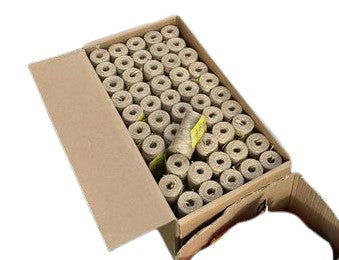
Jute Twine 2mm 100m L, 100g - 100 Spools a Carton
Introducing our Natural Jute Twine, a versatile, eco-friendly, and strong material perfect for various uses. Crafted from sustainable jute plant fibers, it's biodegradable and won't harm the...
From $180.00 AUD