In much of northern and eastern Australia, storm season runs from around November to April. When a severe weather warning is issued, local sandbag collection points get busy fast. Having bags ready before the season starts means you can protect doorways, garages and low points without waiting in a queue.
This guide covers how many sandbags you’re likely to need, how to fill them, how to lay them so they actually slow water down, and how hessian sandbags compare with plastic ones.
Important: sandbags reduce and slow water. They don’t create a watertight seal. Always follow advice from your State Emergency Service (SES), and never stay in a property to sandbag if you’re told to evacuate.
How many sandbags do I need?
It depends on how wide the gap is and how high you need to go. As a rough guide for Axon’s 84 x 36cm hessian sandbags, filled about two-thirds full and laid flat:
- Each filled bag covers around 50–60cm of length, so allow about 2 bags per metre, per layer.
- Each layer adds roughly 10–15cm of height.
- Add about 20% extra to fill gaps and replace any that split.
| Where | Barrier | Approx. bags needed (incl. spares) |
|---|---|---|
| Single doorway (~0.9m) | 2 layers (~25cm high) | 5–6 |
| Single doorway (~0.9m) | 3 layers (~35–40cm high) | 7–8 |
| Sliding door (~2.4m) | 2 layers | 12–14 |
| Single garage door (~2.4–2.7m) | 3 layers | 18–20 |
| Double garage door (~4.8m) | 3 layers | 35–40 |
| Toilets, floor drains and shower drains | 1 bag each | 1 per drain |
Featured in this article
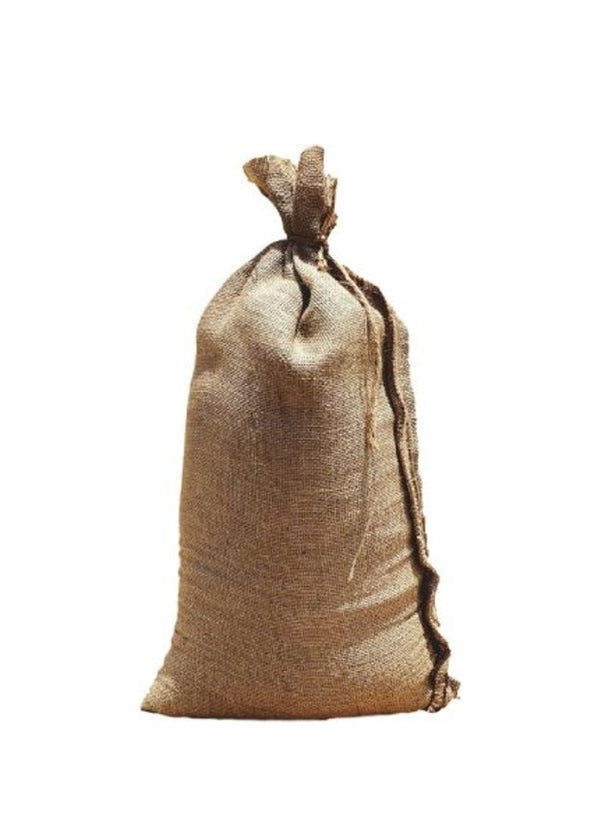
Hessian Sandbags with Drawstring 84cm L x 36cm W 305gsm - Heavy Duty
Axon Hessian Sandbags are eco-friendly bags made from natural jute fiber. They're widely used in flood control, military fortifications, construction, and erosion control. Key Features: ...
From $50.00 AUD
These are estimates for a low barrier along a flat threshold. For anything higher than 3 layers, the barrier needs a wider base (a pyramid shape), which uses far more bags. Get advice from your local SES before building one.
How to fill a sandbag
- Use sand if you can. Sand moulds into gaps and seals better than garden soil. Landscape suppliers sell it by the cubic metre, and many councils provide free sand during storm events.
- Fill to half or two-thirds full. An overfilled bag is rigid and leaves gaps between bags. A two-thirds-full bag weighs roughly 15–20kg, which is manageable to carry and flattens nicely when laid.
- Work in pairs. One person holds the bag open at knee height while the other shovels. It’s quicker and easier on backs.
- Close the bag. Pull the drawstring tight and tie it, or fold the top under the bag when you lay it.
- Wear gloves. Hessian is rough, and wet sand is heavy.
How to lay sandbags properly
- Clear the area. Sweep away debris so the first row sits flat on the ground.
- Add plastic sheeting (optional but effective). Lay heavy plastic sheeting on the side the water will come from, with its bottom edge running under the first row of bags. This improves the seal.
- Lay the first row. Place bags lengthways along the barrier line, with the tied or folded end tucked under and facing the direction the water will come from.
- Overlap the ends. Overlap each bag by about a third with the one next to it, then tamp it down firmly (stand on it or press it with your hands) to remove gaps.
- Stagger the joints. Lay the next row offset by half a bag, like brickwork, so the joints don’t line up.
- Protect drains and toilets. A sandbag in each toilet bowl and over floor and shower drains helps stop sewage backflow during flooding.
Hessian vs plastic (polypropylene) sandbags
| Hessian (jute) sandbags | Polypropylene sandbags | |
|---|---|---|
| Material | Natural jute fibre | Woven plastic |
| Stacking | Rough texture grips well, bags don’t slide | Slippery surface can shift when wet |
| After use | Biodegradable, no plastic left behind | Plastic waste, sheds fragments as it degrades |
| Outdoors | Weathers and eventually breaks down, with no plastic residue | Sunlight makes it brittle and it sheds plastic fragments |
| Shelf life when stored dry | Long, if kept dry and off the ground | Long, if kept out of sunlight |
| Best for | Flood barriers, erosion control, landscaping | Long-term outdoor exposure |
Hessian sandbags will rot faster if left full and wet for long periods, so treat them as an event-season product: store them empty and dry, fill them when needed, and replace them after a flood. Read more about the shelf life of hessian sandbags and the technical data sheet.
After the storm
- Treat used sandbags as contaminated. Floodwater often carries sewage and chemicals. Don’t reuse the sand in gardens or play areas.
- Dispose of them as your council advises. Many councils run collection points after major events.
- Wash your hands and wear gloves when handling used bags.
How to store sandbags before the season
Keep empty hessian sandbags in a dry, well-ventilated spot off the floor, such as a shelf in the garage or a sealed tub. Damp storage is the main thing that shortens their life. If you’ve got space and a reliable sand supply, a small stock of pre-filled bags for your most vulnerable doorway can save valuable time. Keep them dry and check them each season.
Frequently asked questions
Do sandbags stop floodwater completely?
No. They slow water down and reduce how much gets in, but some water will still seep through. Combine them with plastic sheeting, and move valuables up high.
Can I use soil instead of sand?
Yes, if sand isn’t available, but sand works better because it moulds into gaps. Avoid heavy clay, which doesn’t seal well.
Where can I get sand?
Landscape and garden suppliers sell sand in bulk. During storm events, many councils and SES units also provide sand at collection points. Check your council’s website.
How many sandbags does a household need?
A typical house with two or three vulnerable doorways and a garage often needs somewhere between 30 and 60 bags. Use the table above to estimate yours.
Get ready before the first warning. Shop heavy-duty hessian sandbags with drawstrings in household packs, or bulk bales for councils, builders and larger properties.
Featured in this article